Thank you for agreeing to come and inspire my teachers on i-Cube day!
They have not met a Lead Specialist before and I thought it would be good to tap on your wisdom as we celebrate our learning as a school!
Essentially the objectives of the session are:
- Unpack the criteria for quality lesson design using the guiding questions [I have attached the criteria FYI]
- Revisit and reflect on selected SLS lessons created earlier and improve them by applying the criteria OPAL2.0 e-learning course need RO approval
- Leverage digital technology to deepen students’ learning
Your keynote segment is 30 mins. I am proposing that you can:
- Share the essence of e-pedagogy and highlight the SLS Pedagogical Scaffold (SLS PS) 2.0. Good to also mention the integration into STP..so that the teachers can see the linkages/connections

Singapore Teaching Practice
The Singapore Teaching Practice is a model that makes explicit how effective teaching and learning is achieved in Singapore schools. The STP is represented in the form of an orchid to reflect the Singapore context,
1. The Pedagogical Practices 4 core process, 24 teaching areas
2. Curriculum Philosophy - Every child 1.matters, 2 can learn and 3 different interests
3. Knowledge Bases, subject matter and goals, theories and research on teaching + teachers + learning + students
original https://www.moe.gov.sg/about/singapore-teaching-practice 
Centre of Orchid - STP Pedagogical Practices (4 core learning processes inside circle, 24 Teaching Areas )
Learning flourishes in 1 caring and safe learning environments (positive classroom culture)
2 children construct knowledge actively, develop thinking skills (lesson preparation and enactment)
3 assessment to narrow/bridge learning gaps (assessment and feedback)
the real SLS PS
3 design phases (align with STP 2nd, 3rd and 4th quadrants)
10 guiding questions
4 processes are there in Active Learning with Technology, activate, promote, facilitate and feedback
SLS PS is a (1)_design_________ tool to guide teachers to design lessons that bring about (2)__active________ learning with (3)_technology_________.
(1)___SLS_PS______ is an application of the (2)___STP_______.
Lesson PreparationEstablish Learning Outcomes
Lesson Enactment - Design & Facilitate Active Learning with Technology
Assessment & Feedback - Assess Quality of Learning
https://drive.google.com/file/d/1A0zqiDQ-c3_pZh5G5iiDjxFdBuaMi2Q5/view 
SLS Pedagogical Scaffold 1.0 - Touch on Skill-future for Educators SFEd for e-pedagogy

https://www.moe.gov.sg/docs/default-source/document/media/press/2020/infosheet-on-SFEd.pdf
Assessment Literacy (AL) to focus on what matters, and be skilful in diagnosing learning difficulties
Differentiated instructions (DI) HA-MA-LA effect, example, have an optional high ability task, lots of hints and YouTube or image feedback in SLS quiz to guide success in quiz taking
Inquiry based learning (IBL) virtual labs is very promising here as the pedagogy is very similar to real labs. You can request for more simulations from me.
E-pedagogy see another post https://weelookang.blogspot.com/2020/09/e-pedagogy-moe-skillsfuture-for.html for primary school, low lying fruits likeAdaptivity, Interactivity from simulations, Feedback SLS quiz and YouTube hints etc, Choice (SLS lesson solved) ,Non-Linear Access (solved with SLS), Linked Representations (Math concept, pictorial, abstract etc), Open-ended Learner Input (language verbal, textual, equation, video etc), Communication and Collaboration with Other People (project work on real problems)
Character and Citizenship Education CCE - holistic education
Support for students with special educational needs (SEN) inclusive education
1 Emergent (does with support)
2 Proficient (does independently)
3 Accomplished (does skilfully)
4 Leading (leads effectively)
https://www.moe.gov.sg/docs/default-source/document/media/press/2020/infosheet-on-SFEd.pdthe 4 levels … then linking to the design of lessonsShare on the area of quality designs. Often, my teachers find it difficult to examine all 4 criteria simultaneously.Criterion A – Designing For LearnersCriterion B – Designing For Learning OutcomesCriterion C – Designing For Learning EnvironmentCriterion D – Designing For InteractionsHow has the design taken into account students’ readiness (prior knowledge), needs, interest (motivation to learn , 1 engage) and learning progress according to profile?Is the design of the lesson intended for students to develop conceptual understanding (learning by intentional doing, 2 explore ), subject disciplinarity (learning is contextual and authentic) and development of 21CC?Are the learning activities designed to achieve:higher levels of depth of knowledge (DoK)the learning outcomes?How well were the instructional strategies (practice in reasoning , 5 elaborate) and technology and thinking scaffolds (active reflective techniques , 4 elaborate) used to support students in performing the tasks to achieve the learning outcomes?How well did the the technology facilitate Student-Content (S-C), Student-Student (S-S) and Teacher-Student (S-T) interactions (learning is social and collaborative, 3 explain ) ?How were the features of SLS used to support student’s learning?see The BSCS 5E Instructional Model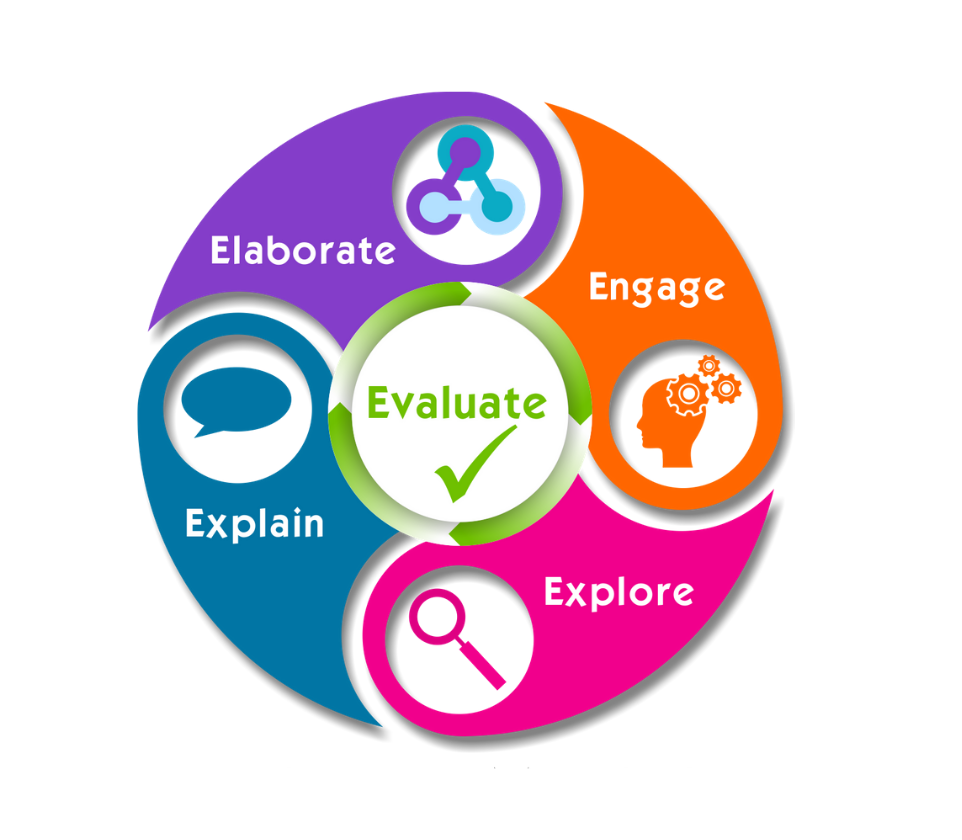
image from https://nasaeclips.arc.nasa.gov/teachertoolbox/the5esee https://weelookang.blogspot.com/2010/04/design-principles-for-e-learning.html
What is your take on this. Also, they may not be that competent in reaching the higher levels of depth of knowledge (DoK).What are your views on this? According to this author https://barbarabray.net/2018/11/02/blooms-taxonomy-and-depth-of-knowledge-dok/ these all just guides with certain origins and purpose in mind, Bloom’s Taxonomy was developed by Benjamin Bloom in 1956 and revised by Anderson and Krathwohl in 2001 as a framework for classifying learning based on different levels of cognitive rigor and complexity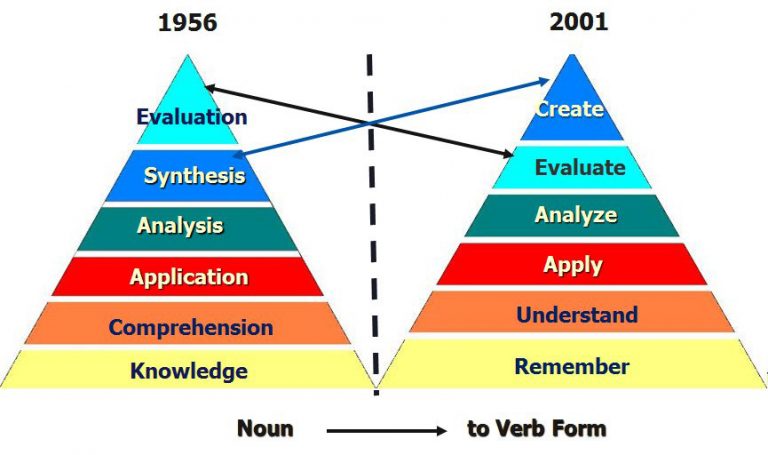
Benjamin Bloom in 1956 and revised by Anderson and Krathwohl in 2001
image from https://barbarabray.net/2018/11/02/blooms-taxonomy-and-depth-of-knowledge-dok/
. The Depth of Knowledge (DOK) was developed in 1997 by Norman Webb, a research scientist from the Wisconsin Center for Education Research, to analyze how deep students think to answer questions and complete activities.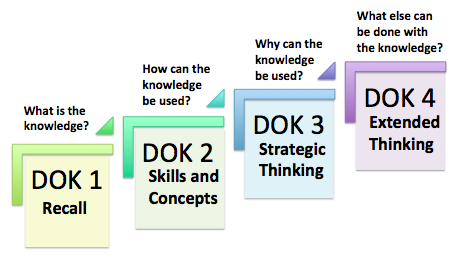
image from https://barbarabray.net/2018/11/02/blooms-taxonomy-and-depth-of-knowledge-dok/Image source: Francis, Erik. ASCD book Now That’s a Good Question!
you use it as you see fit to suit your context, I would use what fits into my own existing prior knowledge, what is the easiest to remember. Thank you for the opportunity to share STP, SLS PS v1 and v2 (with e-pedagogy words), I even learn there is such a thing as 4 criteria of lesson design which I also find it difficult to use. I would instead use the STP for teacher development and pedagogical discussions, SLS PS for SLS lesson design and evolve these 2 ideas to suit the school context because knowledge is context specific and it is the depth of the execution that matters (0.1,0.2,0.3,0.4,...0.9,1.0), it is not a simple binary problem, with only 2 states, 0 or 1.- HQ is only a generalist needing to cater to all schools and is only able to level up to a certain bench mark, to truly excel, the school teachers with the support of school leaders need to be the ones to say this works better and we will keep working on it and de-prioritise the other ideas as we can only work on those ideas that we think we can successfully implement and benefit from, and not be messed up by following blinding all ideas especially what some of them are lacking in reliability, lacking in frequency of articles, authorship, purpose of publication etc on google search. There is a good read here on CRAP detection.
- Actual slides


 |
| Slides |


No comments:
Post a Comment