Pages

Tuesday, December 29, 2020

2021 Global Online Laboratory Consortium (GOLC) International Online Laboratory Award (Visualized Laboratory category)

Email of win!
http://www.online-lab.org/GOLC_online-lab-award.php


Laboratory: Easy experiments with Ejss
Dear Drs. Clemente, Esquembre, Wee, and Leong.

Congratulations!!
It is our pleasure to inform you that after rigorous evaluation, your above submission for the 2021 GOLC International Online Laboratory Award (Visualized Laboratory category) has been selected as the winner.
The award will be presented on during the REV2021 conference (virtual platform). Details of the conference can be found via the link- http://www.rev-conference.org/current/index.php

In addition to the award there will be one complementary conference registration for a team member. It is expected that the individual will provide a demo of the winning laboratory during the conference. The details of the program will be available in due course.

Thanks and looking forward to meeting you (virtually) during the conference.

With regards,

Abul K. M. Azad, President of GOLC
Michael Auer, Secretary General of GOLC
http://www.online-lab.org/GOLC_about.php
-------------------------------------------------------------------------------------
Abul K. M. Azad, PhD
Associate Dean and Professor
Undergraduate Academic Affairs, Outreach and Diversity
College of Engineering and Engineering Technology
Northern Illinois University, USA.
https://www.niu.edu/ceet/
aazad-at-niu.edu
www.niu.edu/azad/
www.niu.edu/remotelab/
President, Global Online Laboratory Consortium (GOLC)
http://www.online-engineering.org/

Submission: The 2021 GOLC International Online Laboratory Award


Presented by the Global Online Laboratory Consortium, www.golc-online.net , info@golc-online.net

Entry Form

The GOLC invites you to submit your successful Online Laboratory course, site, and product or success story, from a university or other institution or school. Please complete this form and submit it via www.conftool.com/rev-conference/.

Submission Deadline: 28 August 2020
Entry Information
Product Name: Easy experiments with EjsS

Entry Category: (mark only one)
☒ Visualized experiment ☐ Simulated experiment ☐ Remote controlled experiment

Laboratory Language(s) (English, Spanish, etc.): English

Organization Information
Entering Organization(s): University of Murcia (Spain) and Ministry of Education Singapore
Organization Web Site: https://www.um.es and https://www.moe.gov.sg/
Name of each individual who are part of this development:


Details of Contact Person:
Name: Félix J. García Clemente
Company: University of Murcia
Address: Facultad de Informática, Campus de Espinardo
City: Murcia
State/Province: Murcia
Zip/Postal Code: 30100
Country: Spain
Entry Details

Description (100-300 words): Easy experiments with EjsS

We present 2 relevant visualised experiments based on Easy JavaScript Simulations running on mobile phones. First, we have developed a spectrometer that uses the phone’s camera with a diffraction grating with 3D printed holder. The spectrometer that can be used to identify gas types such as hydrogen discharge lamp with comparison data from National Institute of Standards and Technology (NIST) .

Figure 1: Spectrometer conducts light experiments. 


And the second one uses the phone’s microphone and simple straws or pipes, can explore and predict the length of the open-close pipe system and the fundamental frequency of the sound produced while blowing across the pipe.

Figure 2: Experiment based on pipe blowing to create sound waves of frequencies.

Easy Javascript Simulations (EjsS), is a free authoring tool written in Java that helps non-programmers create interactive simulations and visualised experiments in Javascript, mainly for teaching or learning purposes. EjsS is part of the Open Source Physics (OSP) project.

Figure 3: Tree and palette of view elements (left) and final HTML user interface (right) for the mass and spring system.


Figure 4: Open Source Physics Singapore (left) and Open Source Physics (USA) digital libraries


OSP provides an open sourced digital library with files for anyone who wishes to run them locally on their computer/mobile/tablet. There are currently 1000+ JavaScript laboratory/experiments, freely distributed.

Audience:

Both Physics teachers and students.

Goals:

  1. Open source web apps and low-cost experimental design
  2. To support Physics education through creating, remixing and disseminating experiments.
  3. To support experiential learning augmenting real experiments to give hope for a better educational experience.

Additional Information (if any):

Entry Access for Our Judges
Link to the Entry or Web portion of the Entry:

First experiment, Spectrometer:
Web App: https://iwant2study.org/ospsg/index.php/643
Youtube: https://www.youtube.com/watch?v=XQiUvY94uMc

Second experiment, measuring straws:
Web App: https://iwant2study.org/ospsg/index.php/820
Youtube: https://www.youtube.com/watch?v=2u_djWwm0u8&t=6s


Optional Additional Links

You may provide us with additional relevant links, such as a narrated video or flash movie in which you show and describe your product. These may be in addition to, or in place of, the link to the lab itself. However, if a link to the lab is possible, it will likely strengthen your application.


Optional Additional Links:

Download EjsS: https://gitlab.com/ejsS/tool/tree/master/Release
Open Source Physics Singapore: https://iwant2study.org/ospsg/
Open Source Physics: https://www.compadre.org/osp/ 


Permissions
The entrant grants permission to the Global Online Laboratory Consortium to publish reviews and reports about this entry, including the entrant's video recording and the entrant's description of the entry. The entrant also grants permission to the Global Online Laboratory Consortium to show the video recording of the entry in meetings, conferences, and webinars.
The entrant warrants that he, she, or the submitting company, is the proprietor of the entry; that they have power to make this agreement; that it does not infringe on any copyright, trademark, patent; or rights in the work.


Submission Process
Please submit this form to us at via the REV submission system:
https://www.conftool.com/rev-conference/


Timeline

Submissions Due: 28 August 2020

Awards Announced: Awards will be announced at our Awards Ceremony in Hong Kong, at the REV2021 Conference in February 2021 (http://www.rev-conference.org/current/). Winners are not required to attend in person, but are of course invited to do so.


Questions?
Please contact us via e-mail to info@golc-online.net.

Tuesday, December 22, 2020

managed to get TagUI to work on Mac

I placed a copy on my desktop so the path is /Users/lookang/Desktop/


$ tagui /Users/lookang/Desktop/tagui/flows/samples/1_google.tag


https://makerspace.aisingapore.org/do-ai/tagui/


How It Works

TagUI converts your intentions in different human languages into lines of working JavaScript code that perform UI automation. Under the hood, it uses:
Chrome DevTools Protocol
Sikuli
CasperJS
PhantomJS
SlimerJS

Installation for macOS/Linux


Download TagUI v6.14 (macOS, Linux).
Unzip the contents to your desktop on macOS, or /home/your_userid on Linux.
Install OpenJDK (macOS, Linux).
Install Chrome.
Open Terminal.
Copy, paste and run these commands, replacing your_tagui_path as needed:
ln -sf /your_tagui_path/tagui/src/tagui /usr/local/bin/tagui 

tagui /your_tagui_path/tagui/flows/samples/1_google.tag


You have run your first TagUI flow! 🎉

Having problems?


Troubleshooting macOS/Linux Setup
If you see dyld: Library not loaded: install OpenSSL in this way. macOS Catalina update has introduced tighter security controls, see solutions for the PhantomJS and Java popups.

$ brew install rbenv/tap/openssl@1.0 ln -sfn /usr/local/Cellar/openssl@1.0/1.0.2t /usr/local/opt/openssl


it should work now on a mac


To make Tagui command work everywhere

$ ln -sf //Users/lookang/Desktop/tagui/src/tagui /usr/local/bin/tagui

Monday, December 7, 2020

Matholicism by chenhongming

  https://sites.google.com/view/matholicism/home?authuser=0

a growing collection of geogebra stuff for O level Math.


https://sites.google.com/view/matholicism/home?authuser=0
a growing collection of geogebra stuff for O level Math by chenhm


Tuesday, December 1, 2020

How to update to PHP 7.3

 How to update to PHP 7.3 on the server


  1. go to your cpanel and login
  2. click on MultiPHP Manager

  3. it should look like this

  4. select the options and click apply

  5. enjoy!


Friday, November 27, 2020

Values and Culture for Company Organisational Excellence

Agility- able to move quickly and easily
taken from 

a.Move fast
b.Be adaptable
c.Have flat structures

Inclusiveness- policy of providing equal access
image from

a.Openness
b.Honesty
c.Care for everyone

Simplicity- straightforward
image from

a.Innovation
b.Craftsmanship
c.Rigor
d. Less is more, just enough best

Teamwork- the combined action of a group
image from

a.Respect & trust
b.Growth
c.Safe work culture

Customer focus- putting your customers' needs first
image from

a.Excellence
b.Empathy
c.Passion

Friday, November 20, 2020

20201126 KCPPS I-Cube Sharing at Kuo Chuan Presbyterian Primary School


Thank you for agreeing to come and inspire my teachers on i-Cube day!
https://photos.app.goo.gl/jkcZD21kwKDWj24u8

They have not met a Lead Specialist before and I thought it would be good to tap on your wisdom as we celebrate our learning as a school!


Essentially the objectives of the session are: 

  1. Unpack the criteria for quality lesson design using the guiding questions [I have attached the criteria FYI]
  2. Revisit and reflect on selected SLS lessons created earlier and improve them by applying the criteria OPAL2.0 e-learning course need RO approval 
  3. Leverage digital technology to deepen students’ learning

Your keynote segment is 30 mins. I am proposing that you can:

  1. Share the essence of e-pedagogy and highlight the SLS Pedagogical Scaffold (SLS PS) 2.0. Good to also mention the integration into STP..so that the teachers can see the linkages/connections 
    Singapore Teaching Practice 
    The Singapore Teaching Practice is a model that makes explicit how effective teaching and learning is achieved in Singapore schools. The STP is represented in the form of an orchid to reflect the Singapore context, 
    1. The Pedagogical Practices 4 core process, 24 teaching areas
    2. Curriculum Philosophy - Every child 1.matters, 2 can learn and 3 different interests
    3. Knowledge Bases, subject matter and goals, theories and research on teaching + teachers + learning + students

    original https://www.moe.gov.sg/about/singapore-teaching-practice

    Centre of Orchid - STP Pedagogical Practices (4 core learning processes inside circle, 24 Teaching Areas )
    Learning flourishes in 1 caring and safe learning environments (positive classroom culture)
    2 children construct knowledge actively, develop thinking skills (lesson preparation and enactment)
    3 assessment to narrow/bridge learning gaps (assessment and feedback)


    the real SLS PS
    3 design phases (align with STP 2nd3rd and 4th quadrants)
    10  guiding questions 
     4 processes are there in Active Learning with Technology, activate, promote, facilitate and feedback
    SLS PS is a (1)_design_________ tool to guide teachers to design lessons that bring about (2)__active________ learning with (3)_technology_________.
    (1)___SLS_PS______ is an application of the (2)___STP_______.
    Lesson PreparationEstablish Learning Outcomes
    Lesson Enactment - Design & Facilitate Active Learning with Technology
    Assessment & Feedback - Assess Quality of Learning
    https://drive.google.com/file/d/1A0zqiDQ-c3_pZh5G5iiDjxFdBuaMi2Q5/view

  2. SLS Pedagogical Scaffold 1.0


  3. Touch on Skill-future for Educators SFEd for e-pedagogy


    https://www.moe.gov.sg/docs/default-source/document/media/press/2020/infosheet-on-SFEd.pdf
    Assessment Literacy (AL) to focus on what matters, and be skilful in diagnosing learning difficulties 
    Differentiated instructions (DI) HA-MA-LA effect, example, have an optional high ability task, lots of hints and YouTube or image feedback in SLS quiz to guide success in quiz taking
    Inquiry based learning (IBL) virtual labs is very promising here as the pedagogy is very similar to real labs. You can request for more simulations from me. 
    E-pedagogy see another post https://weelookang.blogspot.com/2020/09/e-pedagogy-moe-skillsfuture-for.html for primary school, low lying fruits like Adaptivity, Interactivity from simulations, Feedback SLS quiz and YouTube hints etc, Choice (SLS lesson solved) ,Non-Linear Access (solved with SLS), Linked Representations (Math concept, pictorial, abstract etc), Open-ended Learner Input (language verbal, textual, equation, video etc), Communication and Collaboration with Other People (project work on real problems)
    Character and Citizenship Education CCE - holistic education 
    Support for students with special educational needs (SEN) inclusive education


    1 Emergent  (does with support)
    2 Proficient (does independently)
    3 Accomplished (does skilfully)
    4 Leading (leads effectively)
    https://www.moe.gov.sg/docs/default-source/document/media/press/2020/infosheet-on-SFEd.pd

    the 4 levels …
  4. then linking to the design of lessons
  5. Share on the area of quality designs. Often, my teachers find it difficult to examine all 4 criteria simultaneously.  
     Criterion A – Designing For Learners  Criterion B – Designing For Learning Outcomes

    Criterion C – Designing For Learning Environment

     Criterion D – Designing For Interactions

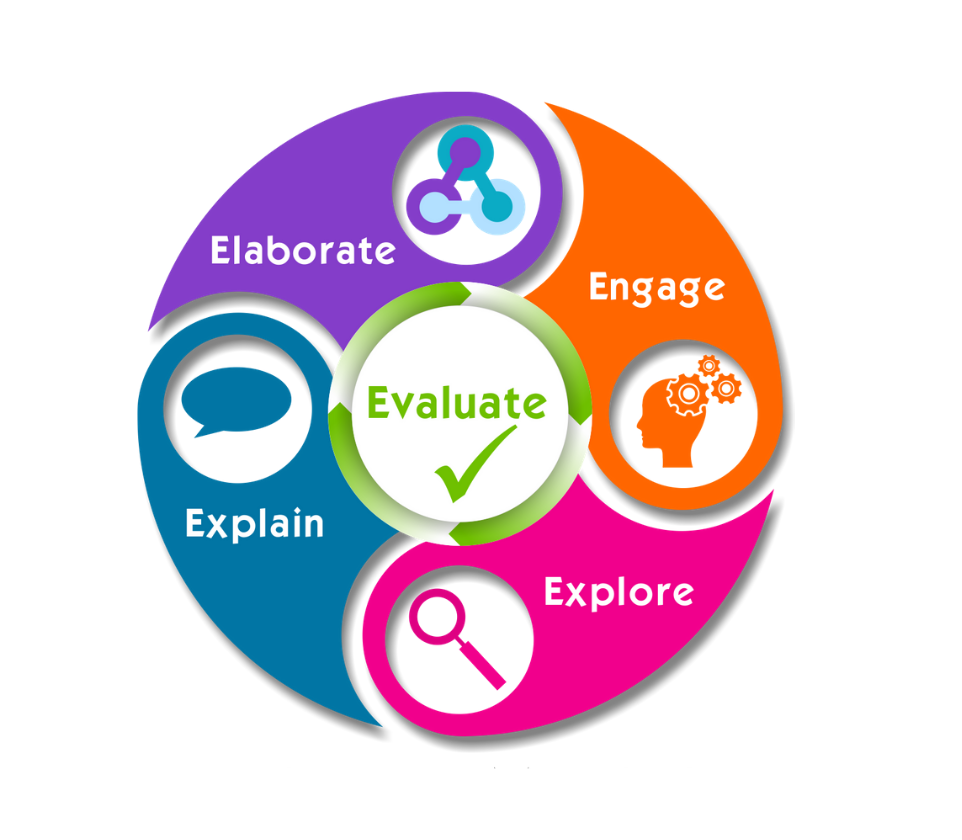
     How has the design taken into account students’ readiness (prior knowledge), needs, interest (motivation to learn , 1 engage) and learning progress according to profile?

    Is the design of the lesson intended for students to develop conceptual understanding (learning by intentional doing, 2 explore ), subject disciplinarity (learning is contextual and authentic) and development of 21CC?

    Are the learning activities designed to achieve:

    higher levels of depth of knowledge (DoK) 

    the learning outcomes?

    How well were the instructional strategies (practice in reasoning , 5 elaborate) and technology and thinking scaffolds (active reflective techniques , 4 elaborate) used to support students in performing the tasks to achieve the learning outcomes? 

    How well did the the technology facilitate Student-Content (S-C), Student-Student (S-S) and Teacher-Student (S-T) interactions (learning is social and collaborative, 3 explain ) ?

    How were the features of SLS used to support student’s learning?

     
    see The BSCS 5E Instructional Model 
    image from https://nasaeclips.arc.nasa.gov/teachertoolbox/the5e

  6. see https://weelookang.blogspot.com/2010/04/design-principles-for-e-learning.html 
     What is your take on this. Also, they may not be that competent in reaching the higher levels of depth of knowledge (DoK). 
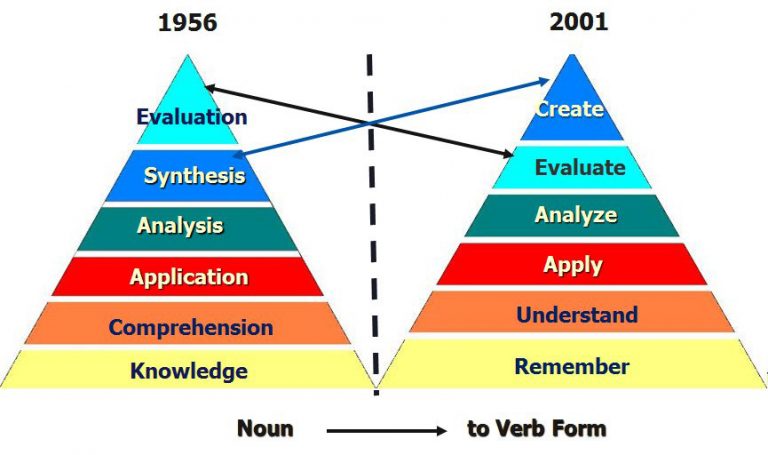
  7. What are your views on this? According to this author https://barbarabray.net/2018/11/02/blooms-taxonomy-and-depth-of-knowledge-dok/ these all just guides with certain origins and purpose in mind,  Bloom’s Taxonomy was developed by Benjamin Bloom in 1956 and revised by Anderson and Krathwohl in 2001 as a framework for classifying learning based on different levels of cognitive rigor and complexity
    Benjamin Bloom in 1956 and revised by Anderson and Krathwohl in 2001
    image from https://barbarabray.net/2018/11/02/blooms-taxonomy-and-depth-of-knowledge-dok/

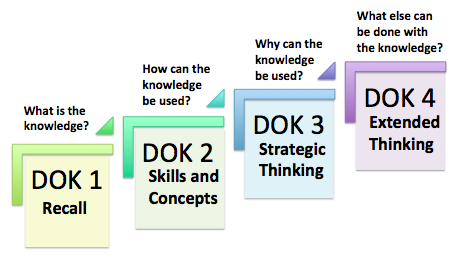
    . The Depth of Knowledge (DOK) was developed in 1997 by Norman Webb, a research scientist from the Wisconsin Center for Education Research, to analyze how deep students think to answer questions and complete activities.
    image from https://barbarabray.net/2018/11/02/blooms-taxonomy-and-depth-of-knowledge-dok/Image source: Francis, Erik. ASCD book Now That’s a Good Question!


    you use it as you see fit to suit your context, I would use what fits into my own existing prior knowledge, what is the easiest to remember. Thank you for the opportunity to share STP, SLS PS v1 and v2 (with e-pedagogy words), I even learn there is such a thing as 4 criteria of lesson design which I also find it difficult to use. I would instead use the STP for teacher development and pedagogical discussions, SLS PS for SLS lesson design and evolve these 2 ideas to suit the school context because knowledge is context specific and it is the depth of the execution that matters (0.1,0.2,0.3,0.4,...0.9,1.0), it is not a simple binary problem, with only 2 states, 0 or 1.
  8.  HQ is only a generalist needing to cater to all schools and is only able to level up to a certain bench mark, to truly excel, the school teachers with the support of school leaders need to be the ones to say this works better and we will keep working on it and  de-prioritise the other ideas as we can only work on those ideas that we think we can successfully implement and benefit from, and not be messed up by following blinding all ideas especially what some of them are lacking in reliability, lacking in frequency of articles, authorship, purpose of publication etc on google search. There is a good read here on CRAP detection.   
  9. Actual slides 

Slides


Resources

Thursday, November 19, 2020

The Theory & Praxis of Agile & Scrum by Gerald


The Theory & Praxis of Agile software development & Scrum by Gerald

https://www.planview.com/resources/guide/agile-methodologies-a-beginners-guide/basics-benefits-agile-method/


Objectives

  1. Be aware of agile principles & features of scrum framework Increase responsiveness of our work, be more value-centred in our delivery
  2. Be aware of agile principles & features of scrum framework Increase responsiveness of our work, be more value-centred in our delivery

Theory, Why Agile?

  • Iterative approach to developing, delivering and sustaining complex products
  • Project progress is continuous, incremental& value-driven

What differentiates Agile?

  1. individuals and interactions over processes and tools
  2. working software over comprehensive documentation
  3. customer collaboration over contract negotiation
  4. responding to change over following a plan
    https://www.planview.com/resources/guide/agile-methodologies-a-beginners-guide/basics-benefits-agile-method/

What are the Agile Principles?

  1. Our highest priority is to satisfy the customer through early and continuous delivery of valuable software.
  2. Welcome changing requirements, even late in development. Agile processes harness change for the customer's competitive advantage.
  3. Deliver working software frequently, from a couple of weeks to a couple of months, with a preference to the shorter timescale.
  4. Business people and developers must work together daily throughout the project.  https://www.gif-vif.com/g/The-reality-of-communication
  5. Build projects around motivated individuals. Give them the environment and support they need, and trust them to get the job done.
  6. The most efficient and effective method of conveying information to and within a development team is face-to-face conversation.
  7. Working software is the primary measure of progress. (don't copy the form, you need to copy the substance, get your software to work!)
  8. Agile processes promote sustainable development. The sponsors, developers, and users should be able to maintain a constant pace indefinitely.
  9. Continuous attention to technical excellence and good design enhances agility.
  10. Simplicity –the art of maximizing the amount of work not done–is essential.
  11. The best architectures, requirements, and designs emerge from self-organizing teams.
  12. At regular intervals, the team reflects on how to become more effective, then tunes and adjusts its behaviour accordingly.

What is Scrum?

A framework to practice agile that is based on empiricism which hinges on transparency, inspection& adaptation


What are the features of Scrum?

  1. Self-organising teams
  2. Cross-functional, self-sufficient
  3. Value-based prioritisation
  4. Activities are time-boxed
  5. Iterativedevelopment
  6. Adaptive to change
  7. Clear enough roles & deliverables
  8. Inherently lean

How is a Scrum team configured?

Product Owner

1.Person responsible for maximising the value of the product & work done
2.Manages& prioritises product backlog
3.Ensures product&sprint backlog is transparent& clear to all
4.Inspects&holds team accountable for sprint deliverables

Development Team

1.3 –8 people group responsible for doing the work of delivering a releasable product increment
2.Works on tasks till it meets acceptance& done criteria
3.Self-organising, cross-functional
4.Flat structure, no titles or sub-teams

Scrum Master

1.Person responsible for promoting & supporting the practice of scrum
2.Facilitates interactions within and outside the scrum team
3.Monitors, coaches, provokes changes to practices, the environment, behaviours to help the team succeed


How is Scrum practised?

Rituals

Sprint
•Fixed, regular period of time (2 weeks) during which a releasable increment is created
•No changes to sprint back log once sprint starts

Planning
•Collaborative discussion (max. 2 hrs) to determine what can be done & how to get it done
•Product backlog to sprint backlog
•Sprint backlog(with criteria) to tasks

Scrum
•Daily 15 min to plan work for the day
•Allows team to inspect work done&sync efforts
•Focus on progress by eliminating impediments

Review
•1 hr at the end of each sprint to review product increment & inspect work done
•Review product backlog& prepare for next sprint

Retrospective
•1 hr at the end of each sprint to review how the teamworks
•Focus on inspection & adaptation to improve team efficacy & performance


Artefacts

Product Backlog
•Ordered list of everything needed for the product
•Never complete but maintained by value-add priority
•Comprises user stories
•Includes acceptance& done criteria

SprintBacklog
•Pulled from the product backlog
•User stories are broken down into tasks
•Tasks under taken by members &with specific deadlines

Scrum Board
•Transparent, shared board showing work in progress
•Columns of product backlogs print backlog, sprint to-dos, sprint in progress, sprint to review, sprint done

Product Increment
•Sum of all product backlog items completed within a sprint
•Must be inspectable and useable
•May or may not be released

Reference:


Information on Senior Specialist Track (SST)

For my own learning. Only general text are shared here

Who are SS?

  • Key custodians and creators of specialised knowledge (Open Source Physics for me)
  • Thought leaders who collectively use their deep knowledge and research skills to innovate, break new ground, and keep organisation at the leading edge in educational developments https://iwant2study.org/ospsg/
  • Providers of professional support and advice to key stakeholders, including facilitating the learning of others in the specialised areas. Sport Science e-Assessment, NT Science e-SBA interactive, H1,H2,H3 A level Physics, Physics Chapter, mentoring of teachers interest to do Tracker and EJSS etc

Thought Leadership is 

  1. Dream & Push Boundaries (Identify possibilities and anticipate opportunities) latest is data analytics in EJSS in 2021 SSTRF proposal and 
  2. Co-create & Re-Create (Ideate, create, and refine ideas with key stakeholders) made 800 simulations with teachers count?
  3. Rally & Moblise (“Tell, Sell, Compel”) selling EJSS as the goto toolkit to generate interactive that is gaining some ground in usage in SEAB and NTScience and Sports Science.


Research as a Key Aspect of Thought Leadership, SSs’ responsibilities in research include:

  • Produce contextually-attuned knowledge, i.e., knowledge that is relevant to Singapore https://iwant2study.org/ospsg/
  • Build public confidence in view of greater public demand for evidence-based policies and programmes https://iwant2study.org/ospsg/
  • Strengthen organisation's capacity to understand and conduct rigorous research, when the world is using EJSS, that is the most rigorous data as it is realtime and from many countries

Two types of Education Research

  1. Research for Doing, to improve specific education policies, programmes, practices or operations, 800 simulations and tracker models
  2. Research for Knowing, to gain a deeper understanding of the phenomena, topics and issues related to learning and teaching https://scholar.google.com.sg/citations?hl=en&user=Tvy7ptIAAAAJ

SS to Focus on Research for Doing! I been telling everyone the same thing but it is difficult to do as they are 'comforted' in research for knowing! My advise is use Open Source tools, Geogebra, EJSS, Desmos etc to create new interactive resources

Dont waste time. If research papers isn't on the internet freely, it is not worth citing. Please maintain your own research in publicly accessible digital libraries to spread your influence. 


SS Clusters –What Are They?

Applied Psychology in Education
Curriculum (I am here)
Educational Research, Evaluation and Measurement

Specialist Growth Model (SGM)

  1. Strategic innovator (innovate with EJSS or OSP community, need a global community)
  2. Empowering Mentor (try to mentor teachers and research assistants to make that own interactive)
  3. Network Leader (i try to include fellow SS who i think can synergise and work well)
  4. Domain Expert (javascript, simulation design, Tracker video modeling)
  5. Ethnical Professional (integrity my foundation)


Wednesday, November 18, 2020

[ETD] Recognition E-Certs for 2020 MOE Innergy (Schools) Award

[ETD] Recognition E-Certs for 2020 MOE Innergy (Schools) Award
Thank to Boon Chien for asking me to build the app

Our heartiest congratulations to your staff for winning the 2020 MOE Innergy (Schools) Award for the project(s):


Introduction

Wave is an oscillation accompanied by a transfer of energy that travels through medium (space or mass)
Waves consist of oscillations or vibrations (of a physical quantity), around almost fixed locations.
Concepts illustrated in the simulations include student hands on tool kit to make waves using many devices line up.
There is also a mathematically generated wave to support students' ideas on wave.


Wave Simulator Demonstration Kit Set: A Pedagogical Action and Reasoning Framework Approach - Commendation Award
Web: https://iwant2study.org/ospsg/index.php/interactive-resources/physics/04-waves/02-general-waves/555-wavehandson
Android: https://play.google.com/store/apps/details?id=com.ionicframework.wavehandson
iOS: https://apps.apple.com/us/app/waves-handson-need-many-device/id1384354352

In recognition of their contribution towards innovation, we have provided e-Certificate(s) for all winners [please see attached folder(s)].

The award trophies will be presented to the Gold and Silver MOE Innergy (Schools) Award and the MOE Outstanding Innovator Award winners during the MOE ExCEL Fest Awards Ceremony on 2 Jun 2021. The admin details will be sent separately closer to the date of the event.

We would greatly appreciate your kind assistance:
Please assist to congratulate and forward the attached e-Certificates of Recognition to the team(s) and/or individual(s) for their retention.
Wave Simulator Demonstration Kit Set: A Pedagogical Action and Reasoning Framework Approach - Commendation Award
Web: https://iwant2study.org/ospsg/index.php/interactive-resources/physics/04-waves/02-general-waves/555-wavehandson


We would like to encourage you to celebrate and recognise the accomplishments of your staff at suitable platforms in your division (e.g. staff meetings).

Thank you very much for your strong support, and we look forward to your division’s continuous contribution towards innovation in MOE! J

Friday, November 13, 2020

Rutherford's Atomic and Thomson's Configurable Plum Atomic-Model JavaScript HTML5 Applet Simulation Model


https://iwant2study.org/ospsg/index.php/324
direct link


Introduction


The Rutherford model was devised by the New Zealand-born physicist Ernest Rutherford to describe an atom. Rutherford directed the Geiger–Marsden experiment in 1909, which suggested, upon Rutherford's 1911 analysis, that J. J. Thomson's plum pudding model of the atom was incorrect. Rutherford's new model for the atom, based on the experimental results, contained new features of a relatively high central charge concentrated into a very small volume in comparison to the rest of the atom and with this central volume also containing the bulk of the atomic mass of the atom. This region would be known as the "nucleus" of the atom.

Computer Model Initial Values


mass of helium atom= 4u where u is the unified atomic mass number

mass of gold atom = 197u

charge of helium atom = 2e where e is the electron charge

charge of gold atom = 79e
Forces

Force is calculated by F = kqQ/r^2 the electrostatic force equation

k = 9.0*0.03 where 0.03 is a factor scaling to scale down/up to fit the x and y dimensions of the computer model, in the nature world k = 9x10^9

q = charge of first particle

Q = charge of second particle

r is the distance that separates the 2 charged particles

Evolution


the ordinary differential equations are

dx[i]/dt = vx[i]

dvx[i]/dt = xForce[i]/m[i]

dy[i]/dt = vy[i]

dvy[i]/dt = yForce[i]/m[i]

where x is the horizontal position of charge particle

i is the array index of all charge particle

t is time

vx is velocity in x direction

xForce is the vector sum of all x-direction forces calculated based on i with all the other [0] to [n] excluding [i] charges particles where n is 80 since it is assumed there will be a maximum number of charges of 80.

m is the mass of charged particles

vy is velocity in y direction

yForce is the vector sum of all y-direction forces calculated based on i with all the other [0] to [n] excluding [i] charges particles where n is 80 since it is assumed there will be a maximum number of charges of 80.

Auto and Manual Selection of combo-box


auto - automatically randomised the y position of a helium He particle back to the edge of the left screen and shoots in vx as the same initial vx

manual - user can drag on the helium particle to try out their choice of particle y -position and investigate the new trajectory
Rutherford Atom-Model Assumption

The gold atom cannot be moved by fixing the velocity in both x and y direction as zero all the time.

There is a single particle at the centre of the atom, charge value = 79 u

Rutherford Atom-Model 2 Assumption


The gold atom is made up of 9 individual charge particles that cannot be moved, they are all fixed in their velocities in both x and y direction to be zero all the time.

There is a group of 9 particles spread out tightly at the centre of the atom, each particle charge is 79u/9. This is a mathematical division as it was too tedious to have 79 particles so to test the model, I just created 9 particles to approximate instead
Thomson Atom-Model configurable Assumption

The gold atom is made up of 9 spread out individual charge particles that can be moved or repositioned, they are all fixed in their velocities in both x and y direction to be zero all the time.

There is a group of 9 particles spread out loosely at the atom, each particle charge is 79u/9. This is a mathematical division as it was too tedious to have 79 particles so to test the model, I just created 9 particles to approximate instead
Thomson Atom-Model configurable each atom Assumption

The gold atom is made up of 79 spread out individual charge particles that can be moved or repositioned for exploration and learning, they are all fixed in their velocities in both x and y direction to be zero all the time.

There is a group of 79 particles spread out loosely at the atom, each particle charge is 79u/79 = 1u. This is the best computer model for Thomson's model of the atom
Experimental basis for Rutherford model

Through conducting inquiry activities on these 4-option computer model, students can obtain computational data (visualise via the histogram or otherwise the He particle trails) and behave like scientists and make conclusions based on evidence rather than from reading texts and looking at static pictures.

Rutherford overturned Thomson's model in 1911 with his well-known gold foil experiment in which he demonstrated that the atom has a tiny and heavy nucleus. Rutherford designed an experiment to use the alpha particles emitted by a radioactive element as probes to the unseen world of atomic structure. If Thomson was correct, the beam would go straight through the gold foil. Most of the beams went through the foil, but a few were deflected.

Rutherford presented his own physical model for subatomic structure, as an interpretation for the unexpected experimental results. In it, the atom is made up of a central charge (this is the modern atomic nucleus, though Rutherford did not use the term "nucleus" in his paper) surrounded by a cloud of (presumably) orbiting electrons. In this May 1911 paper, Rutherford only committed himself to a small central region of very high positive or negative charge in the atom.

Wednesday, November 11, 2020

Without actual Developer in the team

https://www.gif-vif.com/g/The-reality-of-communication

https://www.gif-vif.com/g/The-reality-of-communication

EuphoricInsignificantEidolonhelvum-mobile.mp4

Shortcoming of Design Thinking without actual Developer in the team

  1. Clients - School teacher and students 
  2. Business analyst - Design thinking Designers
  3. Developer - No body in the team, outsourced to coder(s), which I argue for innovation to happen, the developer needs to be part of the team, and not someone we pay for 10 weeks to develop the functional platform.
  4. Code - actual digital solution platform https://iwant2study.org/taskmeister 


So in EJSS case,

  1. Clients - School teachers and students 
  2. Business analyst - me (one man business analyst, sudo developer thank to EJSS)
  3. Developer - me
  4. Code - me and Open Source Physics community maintaining it with lots of improvements and backward compatible 


you see the EJSS innovation for yourself https://iwant2study.org/ospsg/ 

Monday, November 2, 2020

JavaScript_EJS_6.1 BETA_201101 is released by Professor Felix J. Garcia Clemente

 new beta version :-) https://gitlab.com/ejsS/JavaScriptEditor/release

https://gitlab.com/ejsS/JavaScriptEditor/release/-/blob/master/JavaScript_EJS_6.1%20BETA_201101.zip

Several changes and bugs fixed ... New button to add folders into User Files, remember last folder in ImageUrl, editor for Display property, model elements Numerics, property colors in ScalarField, and also fixed your simulation for scalar-field ...

JavaScript_EJS_6.1 BETA_201101
https://gitlab.com/ejsS/JavaScriptEditor/release


JavaScript_EJS_6.1 BETA_201101
https://gitlab.com/ejsS/JavaScriptEditor/release